I want to start by thanking Kim at the Lunch Box, on whose blog I first saw the A to Z Challenge badge, and Lee at Tossing it Out, the force behind the challenge, as well as the other challenge hosts.
As some of you know, I started the Jim's Girl Family History Blog in mid-March 2011 for the purpose of sharing family history and genealogy research among my cousins. I knew nothing of blog challenges, memes, awards or much of anything in blogging culture. Then I saw the challenge badge and decided to find out what it was about. I liked the mental challenge of coming up with genealogy-related stories for each of the 26 letters of the alphabet. I also saw the challenge as a push, "into the deep end" if you will, to post frequently.
I may have underestimated the effort it would take to post 26 times in one month. Whew! I also underestimated how many other A to Z challengers would read my posts and make comments. Remember, my intended audience was just cousins (albeit in some cases fourth cousins once removed, by marriage).
I tried to visit other blogs in the challenge, but a full time job, travel, Easter and the ever-present pressure to write more blog posts limited the number I could read. Nonetheless, the A to Z challenge introduced me to a several interesting blogs I will follow in the future, blogs I'd never have found without the challenge. It also brought me some new followers.
It's true I didn't enjoy the pressure to research and compose on a strict deadline. In the future, you can expect more thoroughly researched, though less frequent posts interspersed with short blurbs on this and that; probably a few posts per week. I hope my cousins will stay with me into the future. And I hope some of the A to Z challengers will continue to follow my posts as well. Who knows, maybe we are cousins after all.
Before I go...thanks to Cousin Sam and my mom for fine-tuning some recipes, to Aunty Anna for the picture of her gorgeous genetti cookies, and to my Sweetie and the Bean for their patience. And, Arlee Bird, how can I thank you enough?!
Check out the reflections of other challengers via Tossing it Out.
A genealogy blog to bring together cousins near and far in my family tree.
Showing posts with label A to Z. Show all posts
Monday, 2 May 2011
Saturday, 30 April 2011
I Survived the A to Z Challenge
Thanks to Elizabeth Mueller for creating this award for all of us that have completed the 2011 A to Z blogging challenge.
Z is for Zucchini Fritti
Today marks the end of the A to Z Challenge of April 2011. As soon as I started thinking about whether I could find a topic for each letter of the alphabet, my daughter the Bean jumped in with an idea for Z: Nona’s fried zucchini.
My mom’s been making these for years, and for the last while, I’ve been helping her. Mine aren’t yet as delicious as hers. I don’t know why, but my mom’s specialties always taste better than my versions. Here’s the recipe for you.
Zucchini Fritti
Ingredients:
- 1-2 medium zucchini, approximately 2-3” diameter is a good size (oops, original post somehow skipped the zucchini, a key ingredient
- Salt
- Flour
- Beaten eggs
- Bread crumbs, seasoned if you like
- Vegetable Oil
Slice the zucchini in coins about a ¼" thick. Salt both sides and spread them in a colander. Leave them a half an hour to an hour to drain excess water.
Pour oil into a skillet, at least ½ deep. Heat the oil to medium heat.
Dredge a piece of zucchini first in flour, then dip it in eggs, followed by bread crumbs, then lay in the hot oil. Fill the pan with the battered zucchini, but don't overcrowd them.
Once the zucchni pieces have turned golden-brown on the bottom, flip them over. Continue to cook until the zucchini pieces are golden-brown on both sides and a fork goes easily into the zucchini. If the oil gets low, add some between batches. It's probably best to let the added oil heat before adding more zucchni to the pan.
Remove the cooked zucchini from the pan and lay on paper towels to absorb excess oil.
Serve warm.
I'd like to thank all the readers who've stopped by during the A to Z Challenge to read and comment. It's been a pleasure to "meet" you.
Friday, 29 April 2011
Y is for Yeo
In 1912, Florence Burrows, daughter of James and Lucy Jane Burrows, married James Yeo in the Crediton District of Devon, England. She was about 24 years of age. Not long afterwards, Florence and James moved to Australia and her brother Alfred joined them before the outbreak of World War I.
I would love to tell you more about their life in Australia and any family there, but there is little that I know, other than that they had a sheep farm on which Alfred worked before he enlisted in the Australian Expeditionary Force.
I can tell you that Yeo is a common Devon name. It derives from an old word for stream or small river. Many Yeo families moved to Australia.
If you are researching the Yeo name, I suggest you check out the work of Mrs. Sheila Yeo of Devon at:
I would love to tell you more about their life in Australia and any family there, but there is little that I know, other than that they had a sheep farm on which Alfred worked before he enlisted in the Australian Expeditionary Force.
I can tell you that Yeo is a common Devon name. It derives from an old word for stream or small river. Many Yeo families moved to Australia.
If you are researching the Yeo name, I suggest you check out the work of Mrs. Sheila Yeo of Devon at:
- the Guild of One-Name Studies Yeo One-Name Study, and
- the her site Yeo Family History and One-Name Study.
Thursday, 28 April 2011
X is for X Marks the Spot
Where eXactly was Martha Burrows born?
Let's start with an easier question: who was Martha Burrows? She was my sweetie's great-great-grandmother. We think that she was Martha Perry before marrying James Burrows. She was born around 1825 and had at least seven children: Alfred, Samuel, Mary, Emma, James, Ellen and Ann. She died in 1907.
But where did she come from? All I can confidently say is that she was born in Somerset, England. Here's what the census records tell us that she was born:
Eventually, I looked at a map. Hurstone was tough to find. It doesn't appear to be a village or hamlet but a house or school near Waterrow, not far from town of Wiviliscombe. The rest are villages and civil parishes forming a crescent moon shape in the far east of Somerset county, England very close to Devon. All are now part of the Taunton Deane District but were formerly in the Wellington Rural District of Somerset.
I've noticed my West Cork relatives giving a variety of places of birth. Having been born on a farm in a small townland, they gave the name of a nearby town when asked their birthplace. I know to expect Bantry, Durrus, Schull and Ballydehob from the Moynihans. I can imagine that if Martha was born in the country she may have done something similar, giving the name of any of the neighbouring villages.
It is frustrating to know that I may never track down where exactly she was born. It was before civil records. I did once find a possible Martha Perry on an index of Wellington District baptismal records. I'll have to track that down, once I am more certain Perry was her maiden name.
TIP: Consider the source.
I should take this opportunity to note that genealogists are frequently faced with conflicting information. When a birthplace is given in a census record, it is considered a primary source when the information is provided by someone who would have first hand knowledge of the individual's birth, such as the person's parents. Otherwise, it is generally a secondary source. A spouse, child, in-law or employer may or may not know the correct information about an individual's birth. Even the individual herself may not know her own birthplace if her family moved when she was very young. Looking at Martha's six census records, I would tend to put the most weight on the information given when Martha herself was the head of household. Yet Hurstone (near Waterrow) and Milverton are as far apart as any of her reported birthplaces get.
So, I must confess, X does not mark the spot. I've spent hours researching and don't yet know eXactly where Martha was born.
Do you know?
Let's start with an easier question: who was Martha Burrows? She was my sweetie's great-great-grandmother. We think that she was Martha Perry before marrying James Burrows. She was born around 1825 and had at least seven children: Alfred, Samuel, Mary, Emma, James, Ellen and Ann. She died in 1907.
But where did she come from? All I can confidently say is that she was born in Somerset, England. Here's what the census records tell us that she was born:
- about 1824 in Bathaelton, Somerset, according to the 1851 and 1861 Censuses of England, when the information was presumably given by her husband James as head of the household.
- about 1826 in Milverton, Somerset, according to the 1871 Census of England, when she would have given the information as head of the household (she was widowed by then).
- about 1825 in Hurstone, Somerset, according to the 1881 Census of England, information again from herself.
- about 1825 in Wiviliscombe, Somerset, according to the 1891 Census of England, where this time the information as likely given by her son-in-law Henry Cottrell.
- and finally about 1825 in Ashbrittle, Somerset, according to the 1901 Census of England, where the information would likely have been provided by her widowed daughter Emma Parsons.
Eventually, I looked at a map. Hurstone was tough to find. It doesn't appear to be a village or hamlet but a house or school near Waterrow, not far from town of Wiviliscombe. The rest are villages and civil parishes forming a crescent moon shape in the far east of Somerset county, England very close to Devon. All are now part of the Taunton Deane District but were formerly in the Wellington Rural District of Somerset.
I've noticed my West Cork relatives giving a variety of places of birth. Having been born on a farm in a small townland, they gave the name of a nearby town when asked their birthplace. I know to expect Bantry, Durrus, Schull and Ballydehob from the Moynihans. I can imagine that if Martha was born in the country she may have done something similar, giving the name of any of the neighbouring villages.
It is frustrating to know that I may never track down where exactly she was born. It was before civil records. I did once find a possible Martha Perry on an index of Wellington District baptismal records. I'll have to track that down, once I am more certain Perry was her maiden name.
TIP: Consider the source.
I should take this opportunity to note that genealogists are frequently faced with conflicting information. When a birthplace is given in a census record, it is considered a primary source when the information is provided by someone who would have first hand knowledge of the individual's birth, such as the person's parents. Otherwise, it is generally a secondary source. A spouse, child, in-law or employer may or may not know the correct information about an individual's birth. Even the individual herself may not know her own birthplace if her family moved when she was very young. Looking at Martha's six census records, I would tend to put the most weight on the information given when Martha herself was the head of household. Yet Hurstone (near Waterrow) and Milverton are as far apart as any of her reported birthplaces get.
So, I must confess, X does not mark the spot. I've spent hours researching and don't yet know eXactly where Martha was born.
Do you know?
Wednesday, 27 April 2011
W is for the Night of the Big Wind
In Irish, it's called "Oídhche na Gaoithe Móire." The Night of the Big Wind took place at Epiphany in 1839. My great-great-grandparents had been married less than a year and I believe they were living at Shantullig North in West Cork at this time. Epiphany is the feast of the three kings bringing gifts to the Baby Jesus. But in Ireland in 1839, Epiphany was about loss.
From the reports I have read, the severity of this particular storm was due to the convergence of different weather systems. First, the country experience heavy snowfall on January 5th. The next morning, on the Feast of the Epiphany, an Atlantic warm front came in. Temperatures rose and dense cloud covered the nation. The snow of the previous day began to melt. Later that day, an Atlantic depression brought a cold front. When it hit the warm air, severe rain and wind were the result. The winds were hurricane force. Imagine what the countryside looked like after such a storm, with its flooding and wind. Many were left homeless. Roofs were blown off, chimneys collapsed, fires broke out. Up to 300 souls were lost. Many animals died and crops set aside for the winter were scattered and destroyed. The impact on tenant farmer with a subsistence living must have been tremendous.
The Night of the Big Wind was such a momentous event in Irish history, that when the British established a state pension in 1909 and many Irish could not prove their age, for lack of birth or baptismal registration, people were asked if they remembered the Night of the Big Wind. If they did, they were old enough for the pension.
My family remembered the Night of the Big Wind. Stories about it were passed down through the generations. Here's how my dad tells the story of the Night of the Big Wind:
From the reports I have read, the severity of this particular storm was due to the convergence of different weather systems. First, the country experience heavy snowfall on January 5th. The next morning, on the Feast of the Epiphany, an Atlantic warm front came in. Temperatures rose and dense cloud covered the nation. The snow of the previous day began to melt. Later that day, an Atlantic depression brought a cold front. When it hit the warm air, severe rain and wind were the result. The winds were hurricane force. Imagine what the countryside looked like after such a storm, with its flooding and wind. Many were left homeless. Roofs were blown off, chimneys collapsed, fires broke out. Up to 300 souls were lost. Many animals died and crops set aside for the winter were scattered and destroyed. The impact on tenant farmer with a subsistence living must have been tremendous.
The Night of the Big Wind was such a momentous event in Irish history, that when the British established a state pension in 1909 and many Irish could not prove their age, for lack of birth or baptismal registration, people were asked if they remembered the Night of the Big Wind. If they did, they were old enough for the pension.
My family remembered the Night of the Big Wind. Stories about it were passed down through the generations. Here's how my dad tells the story of the Night of the Big Wind:
Blowing snow buried houses and people and cattle froze in the drifts. People had to dig their way out from upstairs windows or through the thatched roofs to get out. I remember my father tell the story of a traveler on horseback lost in the storm, who rode his horse across the Clais na-Broine, that is the high field, westward to the field of the house. The wind having piled the snow level across the trench and then froze over so that the rider never realized what he had done when he came knocking at Granda's door.
I would point out that in West Cork is as far south as you can get in Ireland. The Gulf Stream comes right up along that coast, keeping the weather quite mild year round. It is so mild, in fact, that in West Cork, you will see many gardens with small palm trees. At Shantullig North, they don't get snow every winter, and they never get much at one time. The Night of the Big Wind was certainly an exception.
To learn more about the Night of the Big Wind, you can read more on the following sites:
Tuesday, 26 April 2011
V is for Vanda
Vanda is an uncommon first name. Except perhaps in my family. My goodness, you should have been at that family wedding where there was a Vanda, a Fonda and a Wanda in the same room!
My mom was Christened "Vanda Maria." I was always surprised by that. Surely Vanda isn't a Saint's name? Well apparently, there was a Saint Vando, also known as Wando von Fontenelle, who was a Benedictine Abbot in France in the 8th Century. Would you believe there was also a Blessed Vanna? Short for Giovanna. I never thought of Vanna being a nickname for Giovanna. She's also known as Blessed Joan of Orivieto. Anyway...
Vanda is also a type of orchid. This picture is courtesy of Keattikorn. You'll see on Fotosearch that Vandas come in a variety of colours and shapes. Check out the blog Another Yard in Fort Pierce to see more beautiful Vandas.
One year, I bought my mother a Vanda orchid for her birthday. I was pretty proud of that idea. Unfortunately, the orchid probably needed a specialized environment. I don't think it ever flowered. Bummer.
Agatha Christie had characters named Vanda in two of her books. Vanda Polonska appeared in "N or M?" That's one of the Tommy and Tuppence books, which I love. There is also a Vanda Chevenix in "Dead Man's Mirror" or at least in the Poirot episode.
By coincidence, there is also a murder mystery writer from New Zealand named Vanda Symon. I haven't read any of her books yet, but I noticed this blog post of hers which reviews the book "The Poisonous Pen of Agatha Christie" by Michael C. Gerald. I went on an Agatha Christie tear a couple of years ago and read every one of her books and short stories that I could get my hands on. I still have to read one last one, "The Clocks." Our library didn't have it in print form.
One last thing about Vanda: Vandas are great cooks. In our house, when a dish has been particularly well-prepared, we say it's been "vandalized."
My mom was Christened "Vanda Maria." I was always surprised by that. Surely Vanda isn't a Saint's name? Well apparently, there was a Saint Vando, also known as Wando von Fontenelle, who was a Benedictine Abbot in France in the 8th Century. Would you believe there was also a Blessed Vanna? Short for Giovanna. I never thought of Vanna being a nickname for Giovanna. She's also known as Blessed Joan of Orivieto. Anyway...
Vanda is also a type of orchid. This picture is courtesy of Keattikorn. You'll see on Fotosearch that Vandas come in a variety of colours and shapes. Check out the blog Another Yard in Fort Pierce to see more beautiful Vandas.
One year, I bought my mother a Vanda orchid for her birthday. I was pretty proud of that idea. Unfortunately, the orchid probably needed a specialized environment. I don't think it ever flowered. Bummer.
Agatha Christie had characters named Vanda in two of her books. Vanda Polonska appeared in "N or M?" That's one of the Tommy and Tuppence books, which I love. There is also a Vanda Chevenix in "Dead Man's Mirror" or at least in the Poirot episode.
By coincidence, there is also a murder mystery writer from New Zealand named Vanda Symon. I haven't read any of her books yet, but I noticed this blog post of hers which reviews the book "The Poisonous Pen of Agatha Christie" by Michael C. Gerald. I went on an Agatha Christie tear a couple of years ago and read every one of her books and short stories that I could get my hands on. I still have to read one last one, "The Clocks." Our library didn't have it in print form.
One last thing about Vanda: Vandas are great cooks. In our house, when a dish has been particularly well-prepared, we say it's been "vandalized."
Monday, 25 April 2011
U is for Udine
As far as I knew when I was growing up, my grandfather and his Bertolo family were from the Udine. That's how they said it, "the Udine." Udine, is in the Friuli region in the north of Italy. (I started to write Ireland there; clearly my coffee hasn't woken me up yet!)
I also knew they were from a village called Bannia. Eventually, I started to pursue genealogy and needed a better sense of where they came from. That was in the early days of the Internet. Ancestry didn't exist back then. but I was searching out people named Bertolo from around the world. The one I found in Sudbury, Ontario was a cousin. The lovely fellow in the Friuli I couldn't connect to our tree.
This is the Friuli. You see Udine right in the middle. On a detailed map you'll find Bannia just south-east of the City of Pordenone. Bannia is a "frazione," remember. It is a village forming part of a smallish town. You need a detailed map to see it, and I couldn't find a royalty-free one.
So why is it so far away from Udine? Well, Italy is divided into regions (e.g. the Friuli) and each region is further divided into provinces. Back in 1913, when my grandfather came to Canada, Bannia was in the province of Udine. Wikipedia says that the province of Pordenone was created out of part of the province of Udine in 1968. Long after my folks left.
It's a bit odd to blog about the province my family isn't from (or isn't from anymore), but that's the sort of thing that happens when you're following and A to Z challenge and have to blog on U. Come back later in the week and see what we can make of X, Y and Z. I'll give you a hint, Z is delicious.
Saturday, 23 April 2011
T is for Treasure
When I was a little girl, maybe even younger than the Bean is now, my grandmother (we called her Ma) gave me treasure. I remember sitting at the big table in the kitchen with Ma, studying it.
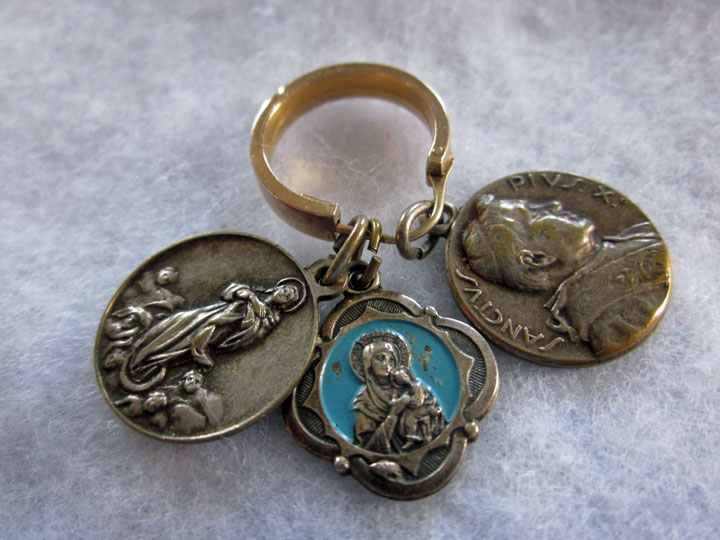
Ma gave me a single gold earring and three religious medals. One was of the Virgin Mary and child, with a light blue background. I think Catholics around the world recognize the colour "Virgin Mary blue." On the other side of the first medal is a male saint holding a cross, with a head or maybe a skull on the table beside him. I had a heck of a time figuring out which saint he was but after an hour or so of Googling, I'm pretty sure he was St. Gerard Majella. I'm embarrassed that I didn't recognize him, having attended St. Gerard Majella parish for at least a decade in Sault Ste. Marie.
The other two medals are identical. In the picture above you can see the two sides of the medal: on one side is Pope Pius X and on the other is the Virgin Mary's assumption into Heaven.
As a little girl, I'll admit, the medals didn't mean a lot to me. But I was pretty excited to have a gold earring. Still, I was needed to know it really was gold. So, I bit it. See the marks?
Ma gave me a single gold earring and three religious medals. One was of the Virgin Mary and child, with a light blue background. I think Catholics around the world recognize the colour "Virgin Mary blue." On the other side of the first medal is a male saint holding a cross, with a head or maybe a skull on the table beside him. I had a heck of a time figuring out which saint he was but after an hour or so of Googling, I'm pretty sure he was St. Gerard Majella. I'm embarrassed that I didn't recognize him, having attended St. Gerard Majella parish for at least a decade in Sault Ste. Marie.
The other two medals are identical. In the picture above you can see the two sides of the medal: on one side is Pope Pius X and on the other is the Virgin Mary's assumption into Heaven.
As a little girl, I'll admit, the medals didn't mean a lot to me. But I was pretty excited to have a gold earring. Still, I was needed to know it really was gold. So, I bit it. See the marks?
I have treated this much better since the day I received and bit it. I usually bring it and my rosary with me when I travel. To keep it safe or to keep me safe? I'm not sure.
This is a treasure,one of many treasures from my grandmother, not the least of which was my time with Ma.
Friday, 22 April 2011
S is for the Skibbereen Heritage Centre
When I was in Ireland in 2008, my West Cork cousins were kind enough to take me to into Skibbereen town to visit the Skibbereen Heritage Centre.
The Centre has a Great Famine Commemoration Exhibition. As you probably know, the Irish famine in the 1840s, known as the Great Hunger, hit West Cork particularly hard. To quote the Centre's website:
The Skibbereen Heritage Centre website provides a variety of information, including the following searchable databases: Loan Fund Database, Graveyard Database, and Townland Database. There are also links to resources, genealogical or not.
I would encourage you to visit the Heritage Centre if you're in West Cork. If you're not, and have West Cork heritage, check out the Centre's website.
Before I go, let me share with you what made me do a double-take on leaving the Skibbereen Heritage Centre.
OK, I realise that seeing a blue Honda Civic isn't surprising, even one this old. Look at the sticker on the hatch, above the lights on the left:
Barrie Honda. Now Barry is a common Irish name. Barry's Tea is very popular. But "Barrie" isn't in Ireland. It is in Ontario. I recognised the sticker, because I'd seen it on Hondas owned by my family members, in Ontario, not West Cork. I still wasn't sure that this car was from Barrie, Ontario till I looked more closely at the steering wheel. Look. Left hand drive as opposed to the cars on either side.
Why on earth there was a car from Barrie Honda in the parking lot of the Skibbereen Heritage Centre in West Cork! Any guesses?
The Centre has a Great Famine Commemoration Exhibition. As you probably know, the Irish famine in the 1840s, known as the Great Hunger, hit West Cork particularly hard. To quote the Centre's website:
From newspaper accounts of the time, Skibbereen was depicted as being symbolic of the destitution and hardship caused by the failure of the potato crop. Between 8,000 and 10,000 unidentified souls are buried in the Famine graveyard at Abbeystrewery near Skibbereen.In addition to helping to teach people how our West Cork ancestors lived and died, the Centre provides assistance with genealogical studies. When I visited, a lovely lady found and copied the Griffith's Valuation and 1901 Irish Census forms for my Moynihan and Leahy ancestors. Today we're lucky to be able to access them free online. The Centre also holds parish registers for a number of West Cork Roman Catholic parishes, alas not Schull, and will do lookups.
The Skibbereen Heritage Centre website provides a variety of information, including the following searchable databases: Loan Fund Database, Graveyard Database, and Townland Database. There are also links to resources, genealogical or not.
I would encourage you to visit the Heritage Centre if you're in West Cork. If you're not, and have West Cork heritage, check out the Centre's website.
Before I go, let me share with you what made me do a double-take on leaving the Skibbereen Heritage Centre.
OK, I realise that seeing a blue Honda Civic isn't surprising, even one this old. Look at the sticker on the hatch, above the lights on the left:
Barrie Honda. Now Barry is a common Irish name. Barry's Tea is very popular. But "Barrie" isn't in Ireland. It is in Ontario. I recognised the sticker, because I'd seen it on Hondas owned by my family members, in Ontario, not West Cork. I still wasn't sure that this car was from Barrie, Ontario till I looked more closely at the steering wheel. Look. Left hand drive as opposed to the cars on either side.
Why on earth there was a car from Barrie Honda in the parking lot of the Skibbereen Heritage Centre in West Cork! Any guesses?
Thursday, 21 April 2011
R is for Rosa Bacchiochi AKA Rosone
My great-grandfather Augusto Mattioli’s mother was Rosa Bacchiochi. She was known as Rosone, which means Big Rosa.
The story goes that Rosa would go to the neighbourhood bar and order some bread and wine. Usually, she would finish the bread before she finished the wine, so she would order more bread. But then she’d finish the wine and still have bread. So, she would order more wine. This could go on for some time. I suspect she had to be carried home.
No wonder she was Big Rosa.
The story goes that Rosa would go to the neighbourhood bar and order some bread and wine. Usually, she would finish the bread before she finished the wine, so she would order more bread. But then she’d finish the wine and still have bread. So, she would order more wine. This could go on for some time. I suspect she had to be carried home.
No wonder she was Big Rosa.
Wednesday, 20 April 2011
Q is for Quotations, Familial Quotations
You’ve heard of Familiar Quotations. Here are some Familial Quotations.
Marital Advice
James Moynihan, to his daughter on her wedding day, "Now that you’re married, you’ve got to make the best of it." Initially I found that sad, but after twelve years of marriage I see it as wise. I only want one marriage. I picked the right guy. Now let’s make the best of it. If you look at the Bean, you’ll see we’re on track.
Luisa Bertolo, to one granddaughter on her marriage, "Feed your chickens in your own yard so they don't go pecking in the neighbours yard!" She told a great-granddaughter to never let a man have all the money and to not let them drink or play cards. She told another granddaughter never to marry a drunk or a loud mouth.
Cooking Advice
Helen Kazuke, when asked how much of an ingredient to use in a dish, "enough."
Lina and Luisa Bertolo, "eat, eat!"
Familiar Sayings
Luigi Bertolo, whenever we arrived at his house, "What’d you bring me?" When his brother Frank died years later, I could see him being met by Louie at the Pearly Gates with the same question.
Floyd Freamon, almost any day, but especially during an energetic game of Pass the Ace, "great gobs of rat shit!" And a favourite of one granddaughter, "bless your pea pickin' li'l heart."
Mary Freamon, "well, shit."
Gordon Burrows, after a sneeze, "God bless my pointy little head." Or when confronted by something sticky, "that sticks like shit to a woolly blanket." During a long, detailed reminiscence, "but he’s dead now."
Luisa Bertolo, "mamma mia!" and "eh, what you goin' to do?" Then there is "mannaggia!" and my personal favourite, "accidenti!" both of which are roughly the Italian equivalents of "darn it."
The Unexpected
Vanda Moynihan, after a couple of weeks in Italy, thinking back on buying a bunch of gifts in Loreto, "Kathy, I think we got hosed on the rosaries."
James Moynihan, after I confessed to kicking a hole in the wall (aiming at my brother), "well, that’s a fine kettle of fish."
Kevin Moynihan, in response to his father’s suggestions for repairing a fan on a wonky stand, "I do NOT need a screw!"
Gordon Burrows, a man known for long stories and corny jokes: "We were so poor, my parents had to cut a hole in the front of my pants to give me something to play with." That’s a nice one to use on your son’s new girlfriend. Lucky for me, I’m not easily frightened.
Last words
Lina Bertolo, from her hospital bed, days before her death, "Kathy, I’m finished."
Gordon Burrows, as the priest finished praying over him, "Amen," which means "so be it."
And here is one final bit of advice from Ma, Luisa Bertolo: "go to church." You can start this Sunday.
Marital Advice
James Moynihan, to his daughter on her wedding day, "Now that you’re married, you’ve got to make the best of it." Initially I found that sad, but after twelve years of marriage I see it as wise. I only want one marriage. I picked the right guy. Now let’s make the best of it. If you look at the Bean, you’ll see we’re on track.
Luisa Bertolo, to one granddaughter on her marriage, "Feed your chickens in your own yard so they don't go pecking in the neighbours yard!" She told a great-granddaughter to never let a man have all the money and to not let them drink or play cards. She told another granddaughter never to marry a drunk or a loud mouth.
Cooking Advice
Helen Kazuke, when asked how much of an ingredient to use in a dish, "enough."
Lina and Luisa Bertolo, "eat, eat!"
Familiar Sayings
Luigi Bertolo, whenever we arrived at his house, "What’d you bring me?" When his brother Frank died years later, I could see him being met by Louie at the Pearly Gates with the same question.
Floyd Freamon, almost any day, but especially during an energetic game of Pass the Ace, "great gobs of rat shit!" And a favourite of one granddaughter, "bless your pea pickin' li'l heart."
Mary Freamon, "well, shit."
Gordon Burrows, after a sneeze, "God bless my pointy little head." Or when confronted by something sticky, "that sticks like shit to a woolly blanket." During a long, detailed reminiscence, "but he’s dead now."
Luisa Bertolo, "mamma mia!" and "eh, what you goin' to do?" Then there is "mannaggia!" and my personal favourite, "accidenti!" both of which are roughly the Italian equivalents of "darn it."
The Unexpected
Vanda Moynihan, after a couple of weeks in Italy, thinking back on buying a bunch of gifts in Loreto, "Kathy, I think we got hosed on the rosaries."
James Moynihan, after I confessed to kicking a hole in the wall (aiming at my brother), "well, that’s a fine kettle of fish."
Kevin Moynihan, in response to his father’s suggestions for repairing a fan on a wonky stand, "I do NOT need a screw!"
Gordon Burrows, a man known for long stories and corny jokes: "We were so poor, my parents had to cut a hole in the front of my pants to give me something to play with." That’s a nice one to use on your son’s new girlfriend. Lucky for me, I’m not easily frightened.
Last words
Lina Bertolo, from her hospital bed, days before her death, "Kathy, I’m finished."
Gordon Burrows, as the priest finished praying over him, "Amen," which means "so be it."
And here is one final bit of advice from Ma, Luisa Bertolo: "go to church." You can start this Sunday.
Tuesday, 19 April 2011
P is for Podcasts
I don’t know about you, but I’m new to podcasts. Have you tried them yet? After attending a BIFHSGO meeting a few months back on podcasts, I took the plunge.
A podcast is like an on-demand radio show. Podcast producers typically have a weekly or monthly schedule and, on their websites, they publish program notes and a downloadable sound file of the show. Most shows last about 45 minutes to one hour. Often, they include interviews. You can listen to the show from your computer or copy it onto your MP3 player. You can also subscribe to a favourite podcast to receive it automatically. And they're generally free.
I'll be honest with you, it took me a while to figure out how to subscribe and how to access what I'd subscribed to. There are some options. I'll just tell you how I got it to work.
I loaded iTunes on my computer. From the iTunes Store, I searched the available podcasts by keyword (try genealogy and family history). Then I selected the ones to which I wanted to subscribe. Now, each time I open iTunes, it automatically downloads the newest podcasts onto my computer. iTunes also shows me past podcasts from a particular series and I can click the "Get" button to manually download ones of interest. That was the straightforward part. I had trouble figuring out where iTunes was putting my podcasts. Eventually, I found them saved in My Libraries\Music\iTunes\iTunesMedia\Podcasts. From there I could easily copy them to the MP3 player. I found this article on Ancestry that provides information on podcasts, including how to listen to them and how to make them.
There are several worthwhile genealogy podcasts to consider. You can find genealogy podcasts on Cyndi's List or simply by Googling "genealogy podcast." Here's a little bit about the podcasts I enjoy:
The Genealogy Guys Podcast is generally posted once or twice a month Drew and George report on newly available genealogical collections and genealogy news.
Family Tree Magazine's Podcast is a monthly podcast hosted by Lisa Louise Cooke which "takes you behind the scenes to learn more about the topics covered in the magazine. Lisa has two other podcasts. Genealogy Gems episodes are available twice a month and cover a variety of topics such as new sources of information and new technologies. She no longer appears to be producing Family History: Genealogy made Easy, which was targeted to new genealogists, but the old episodes, up to the Fall of 2009 are available from iTunes.
I would also recommend you check out the Irish Roots Café, which has several podcast series offered through its Hedge Row School. I like the "Hello Fada" series of short introductions to the Irish language. If you want three ways to say how are you as well as how to answer, Hello Fada is for you. The podcast "Counting up" reminded me of my dad teaching me to count to 10 in Irish when I was a kid. The Hedge Row School also offers podcasts on "Irish Family History." Each episode features particular surnames and locations. This one is offered in two versions: plain audio and photo enhanced. You can also find "Irish Songs and Recitation," "Irish in America" and "Irish History."
I hope you'll try some of these out. They are fantastic resources both for the beginner and experienced genealogists. Some days, I wish my bus ride was longer, so I could listen to more of them!
A podcast is like an on-demand radio show. Podcast producers typically have a weekly or monthly schedule and, on their websites, they publish program notes and a downloadable sound file of the show. Most shows last about 45 minutes to one hour. Often, they include interviews. You can listen to the show from your computer or copy it onto your MP3 player. You can also subscribe to a favourite podcast to receive it automatically. And they're generally free.
I'll be honest with you, it took me a while to figure out how to subscribe and how to access what I'd subscribed to. There are some options. I'll just tell you how I got it to work.
I loaded iTunes on my computer. From the iTunes Store, I searched the available podcasts by keyword (try genealogy and family history). Then I selected the ones to which I wanted to subscribe. Now, each time I open iTunes, it automatically downloads the newest podcasts onto my computer. iTunes also shows me past podcasts from a particular series and I can click the "Get" button to manually download ones of interest. That was the straightforward part. I had trouble figuring out where iTunes was putting my podcasts. Eventually, I found them saved in My Libraries\Music\iTunes\iTunesMedia\Podcasts. From there I could easily copy them to the MP3 player. I found this article on Ancestry that provides information on podcasts, including how to listen to them and how to make them.
There are several worthwhile genealogy podcasts to consider. You can find genealogy podcasts on Cyndi's List or simply by Googling "genealogy podcast." Here's a little bit about the podcasts I enjoy:
The Genealogy Guys Podcast is generally posted once or twice a month Drew and George report on newly available genealogical collections and genealogy news.
Family Tree Magazine's Podcast is a monthly podcast hosted by Lisa Louise Cooke which "takes you behind the scenes to learn more about the topics covered in the magazine. Lisa has two other podcasts. Genealogy Gems episodes are available twice a month and cover a variety of topics such as new sources of information and new technologies. She no longer appears to be producing Family History: Genealogy made Easy, which was targeted to new genealogists, but the old episodes, up to the Fall of 2009 are available from iTunes.
I would also recommend you check out the Irish Roots Café, which has several podcast series offered through its Hedge Row School. I like the "Hello Fada" series of short introductions to the Irish language. If you want three ways to say how are you as well as how to answer, Hello Fada is for you. The podcast "Counting up" reminded me of my dad teaching me to count to 10 in Irish when I was a kid. The Hedge Row School also offers podcasts on "Irish Family History." Each episode features particular surnames and locations. This one is offered in two versions: plain audio and photo enhanced. You can also find "Irish Songs and Recitation," "Irish in America" and "Irish History."
I hope you'll try some of these out. They are fantastic resources both for the beginner and experienced genealogists. Some days, I wish my bus ride was longer, so I could listen to more of them!
Monday, 18 April 2011
O is for Oro alla Patria

In the end, one of the treasures we found wasn’t hidden away at all. It was lying on the floor and could easily have been discarded.
This is the story of Oro alla Patria.
Once we had removed almost everything from the apartment, we started cleaning. Dad was vacuuming near the kitchen when he heard the vacuum knock something metallic. He bent over and picked up what seemed to be some sort of steel band. He put it on the stove and continued vacuuming. I came by a while later and saw this thing on the stove. I picked it up and gave it a good “what the heck is this” look. Hmm. It appeared to be made of steel. It was two centimetres in diameter and a half-centimetre thick. It was rounded over, like a ring for your finger. I looked inside and was surprised to see engraving: ORO ALLA PATRIA 18.11.35.XIV.[another digit or three I can't make out].
What the heck?!? Oro alla Patria?!?
That evening, I showed the ring to Aunty Mary. She said that Ma had been wearing that ring for a few months before she died, but Aunty Mary hadn’t seen the ring before that.
When I googled Oro alla Patria at Aunty Mary’s, I found that back in the mid-1930s, Italy was suffering from the economic recession and and Mussolini asked Italians to give their gold to the government. The campaign was called “Oro alla patria” or gold for the fatherland. Apparently his wife donated her wedding rings and Marconi gave his Senatorial medal. In return, some people were given steel armbands or rings engraved Oro alla Patria.
How had this ring come to be in Ma's home? Mom remembered a story about Ma’s mother having given up her wedding band. But Nona Filomena had come to Canada in 1929, with Ma and Aunty Lina. Her husband Augusto had been here for over fifteen years at that point.
But, in 1938, Nona Filomena returned to Italy to sell the house there before the Second World War – good thing, because when Mom and I were in Fano in 2000, the house could no longer be found. (One day I’ll try to find out if it was bombed in the war or the city just decided to tear it down.) It could be that she decided, while she was in Italy, to give up her wedding ring and received the steel ring in its place.
Why would she give up the ring? Was she so loyal to Mussolini, even after a decade in Canada? Was she pressured to give it up while she was there, perhaps to facilitate the sale of the house? Or did it reflect her feelings about her marriage? In another post, I’ll tell you more about Augusto, but in short, he doesn’t appear to have been an ideal husband.
We don’t even know for sure that it was Nona who received the steel ring or what she gave up for it. I may be able to get a record from Italian archives to confirm if it was Nona. Even so, we would never know why she would have given up her ring.
I imagine that Nona’s gold wedding band would have greater monetary value than this steel ring. But money isn’t everything.
What do you have from your grandmother or greatgrandmother? Does it have monetary value or sentimental value?
Saturday, 16 April 2011
N is for Nora's School Paper
I mentioned in the “H is for Hanora” post that I stumbled upon a piece of my Aunty Nora’s homework once when I Googled “Hanora Moynihan.” Let me tell you more about that.
Google took me to the Irish Virtual Research Library and Archive and the "Schools' Manuscript Collection - My Home District / Bailiuchan na Scol - Mo Cheantar Féin" from 1936-37." The collection description says, "this sub-collection consists of a series of selected essays by schoolchildren from participating counties in Munster and Connacht entitled 'My Home District', a topographical description of their own locality which they were encouraged to write."
The children were encouraged to consult their parents and elders in the community and write up some of the history of their areas. I’ve looked at a few in the collection – and unfortunately, unlike what we’ve gotten used to with some other digitized collections like on Ancestry, you cannot browse this collection. You can however search in two useful ways. If you search by family name, you will get results either for the child who was the author of the paper, or sometimes for the adult who provided the information. You can also type in the name of a townland of interest and see if a paper was done on it. It is hit and miss. It would appear that a few children per school were selected, so not all townlands in Munster (Counties Cork, Kerry, Limerick, Tipperary, Clare and Waterford) and Connacht (Counties Galway, Mayo. Sligo, Leitrim, Roscommon) were covered. I did however find a full list of the papers included in the collection here.
My Aunt Nora’s paper, titled “My Home District,” lists the families resident at Shountullig, allowing us to compare the information to the previous censuses (which I will do in a future post on Shountullig). She was 12 when she prepared the paper. Here is the text:
Aunty Nora’s paper leaves us with one mystery.
P.S. Wasn’t her handwriting lovely?
Google took me to the Irish Virtual Research Library and Archive and the "Schools' Manuscript Collection - My Home District / Bailiuchan na Scol - Mo Cheantar Féin" from 1936-37." The collection description says, "this sub-collection consists of a series of selected essays by schoolchildren from participating counties in Munster and Connacht entitled 'My Home District', a topographical description of their own locality which they were encouraged to write."
The children were encouraged to consult their parents and elders in the community and write up some of the history of their areas. I’ve looked at a few in the collection – and unfortunately, unlike what we’ve gotten used to with some other digitized collections like on Ancestry, you cannot browse this collection. You can however search in two useful ways. If you search by family name, you will get results either for the child who was the author of the paper, or sometimes for the adult who provided the information. You can also type in the name of a townland of interest and see if a paper was done on it. It is hit and miss. It would appear that a few children per school were selected, so not all townlands in Munster (Counties Cork, Kerry, Limerick, Tipperary, Clare and Waterford) and Connacht (Counties Galway, Mayo. Sligo, Leitrim, Roscommon) were covered. I did however find a full list of the papers included in the collection here.
My Aunt Nora’s paper, titled “My Home District,” lists the families resident at Shountullig, allowing us to compare the information to the previous censuses (which I will do in a future post on Shountullig). She was 12 when she prepared the paper. Here is the text:
“The name of my townland is Shountullig. It is in the parish of Schull and in the West Division of West Carbery. There is a population of about forty-six people in it. There is one Cullinane family, one Sullivan family, three Levis families, one Donovan family, one Moynihan family, one Hayes family, one Hodnett family and one Copithorne family and one Hegarty man in the townland. There are four Protestant families and seven Catholic families in it. There is but one person over seventy living there. She is eighty-three years of age. Her name is Mrs. Moynihan.
Houses were more numerous in former times. The old ruins were knocked down and drawn away. Some people sold their farms and went to live in America or Australia and other countries.Perhaps you didn’t realize that in the Republic of Ireland there were so many Protestant families, over forty percent in this townland. In West Cork, the Catholic and Protestant families lived and worked closely together. It was only a year or so ago, when I was studying the 1901 and 1911 Censuses, that I realized that the Levis family that my dad had spoken of with such regard was a Protestant family.
Nora Moynihan,
Shountullig,
Dunbeacon,
Durrus
Obtained from my father, John Moynihan, 40 years”
Aunty Nora’s paper leaves us with one mystery.
Who is the eighty-three year old Mrs. Moynihan? There was only one Moynihan family in the townland, my dad’s. Their grandmother, who would have been a Mrs. Moynihan, had died in 1933. Who was this Mrs. Moynihan? Perhaps she was a mother-in-law living with one of the other families? We haven’t figured it out yet. Dad very young in 1936 and doesn’t remember. He called Aunty Nora in Ireland and she couldn’t recall either. Would you remember the details of homework you did seventy-five years ago?
P.S. Wasn’t her handwriting lovely?
Friday, 15 April 2011
M is for Munster
Ireland is divided into four provinces: Munster, Ulster, Connacht, and Leinster. Munster makes up the south-west corner of Ireland and includes the following counties: Clare, Cork, Kerry, Limerick, Tipperary and Waterford.
My dad is a Munster man. He was born in Munster. And his surname, Moynihan, means "Munsterman." I was going to tell you all about the name Moynihan today, but I will have to save that for another day.
Thursday, 14 April 2011
L is a Limerick
There once was a girl named Kate,By Katherine Moynihan
who had a discouraging trait:
no matter what makeup
or perfume or hairdo,
she couldn't find someone to date.
(who, as you know, managed eventually to find someone great to date)
Wednesday, 13 April 2011
K is for Katie Leahy
This is Katie Leahy, my grandmother, with her father Dick Leahy. The photo was taken in the early 1900s, likely at their home in Gortnamona, in West Cork
The other day, I mentioned Irish naming patterns. I was named after Katie because I'm the first-born daughter in my family. I have three cousins named Catherine for the same reason (though one is the second-born girl -- one day I have to ask about that).
Katie died in 1959, shortly after my dad came to Canada... years before I was born. She had had a series of strokes that had weakened her before her death. That's about all I know about her. Recently, dad mentioned the his mom used to crochet -- baby clothes and things.
My girl, the Bean, is also named after her paternal grandmother, who also died years before she was born. Her Baba was Helen Kazuke. We don't have a lot of pictures of Baba, but there are two in the family room, where they should be. And we tell the Bean lots of stories about her Baba.
I think a girl should know who her grandmother is. My grandmother and the Bean's both crocheted. So do the Bean and I.
What do you have in common with your grandmother?
The other day, I mentioned Irish naming patterns. I was named after Katie because I'm the first-born daughter in my family. I have three cousins named Catherine for the same reason (though one is the second-born girl -- one day I have to ask about that).
Katie died in 1959, shortly after my dad came to Canada... years before I was born. She had had a series of strokes that had weakened her before her death. That's about all I know about her. Recently, dad mentioned the his mom used to crochet -- baby clothes and things.
My girl, the Bean, is also named after her paternal grandmother, who also died years before she was born. Her Baba was Helen Kazuke. We don't have a lot of pictures of Baba, but there are two in the family room, where they should be. And we tell the Bean lots of stories about her Baba.
I think a girl should know who her grandmother is. My grandmother and the Bean's both crocheted. So do the Bean and I.
What do you have in common with your grandmother?
Labels:
A to Z,
Gortnamona,
Kazuke,
Leahy,
Naming Patterns,
West Cork
Tuesday, 12 April 2011
J is for Jeremiah
It is fitting that my grandparents were Hanora and Jeremiah. Both names are somewhat peculiar to West Cork and both have a few variations.
The Jeremiahs in my family have been known as Jerh or Jerry. You will occasionally find Jer. And when I was in Ireland in 1989, I met a colourful fellow known by the short form Miah.
I like the idea of naming a girl Jeremiah and calling her Miah for short. Wouldn't that be cool? My Sweetie didn't think so.
Did you know that Dermot is a form of Jeremiah? From what I've read, there was a period of time when the Catholic Church operating in Ireland tried to Latinize names. You'll see this also in some old Sault Ste. Marie Catholic records where the Italian Marys I know were baptized Maria. It's less obvious to Latinize Irish Gaelic names. Apparently, Con and Connor became Cornelius. And Dermot and Diarmaid became Jeremiah. Another form of Dermot, and hence Jeremiah, is Darby. We refer to our original Moynihan ancestor (as far back as we have been able to take the tree) as Big Darby Mynehane. You'll find him called Jeremiah Mynehane on some Ancestry trees online.
One last thing. In case you don't yet have the song running through your head, let me share what inspired this post: "Jeremiah was a Bullfrog."
No he wasn't, he was my ancestor.
The Jeremiahs in my family have been known as Jerh or Jerry. You will occasionally find Jer. And when I was in Ireland in 1989, I met a colourful fellow known by the short form Miah.
I like the idea of naming a girl Jeremiah and calling her Miah for short. Wouldn't that be cool? My Sweetie didn't think so.
Did you know that Dermot is a form of Jeremiah? From what I've read, there was a period of time when the Catholic Church operating in Ireland tried to Latinize names. You'll see this also in some old Sault Ste. Marie Catholic records where the Italian Marys I know were baptized Maria. It's less obvious to Latinize Irish Gaelic names. Apparently, Con and Connor became Cornelius. And Dermot and Diarmaid became Jeremiah. Another form of Dermot, and hence Jeremiah, is Darby. We refer to our original Moynihan ancestor (as far back as we have been able to take the tree) as Big Darby Mynehane. You'll find him called Jeremiah Mynehane on some Ancestry trees online.
One last thing. In case you don't yet have the song running through your head, let me share what inspired this post: "Jeremiah was a Bullfrog."
No he wasn't, he was my ancestor.
Monday, 11 April 2011
I is for Irish Censuses
In a number of previous posts, I have mentioned the Irish Census of 1901 and 1911. Wondering why I haven't mentioned earlier censuses? Censuses were taken in Ireland every ten years starting in 1821, but very little of them survive. This page from the Irish National Archives tells you which counties have some (I repeat "some") remaining early censuses.
Because so little is available, many Irish family historians rely on census substitutes such as the Griffith's Valuation which list the heads of households of virtually all the households in Ireland. The information in the Griffith's Valuation is certainly helpful but it does not give you a full list of inhabitants nor any indication of dates of birth.
As such, for those of us whose ancestors left Ireland late, the 1901 and 1911 Irish Censuses offer a gold mine of information. The data varies somewhat between the two censuses, but I've found wonderful information such as:
Yay Canada!
Because so little is available, many Irish family historians rely on census substitutes such as the Griffith's Valuation which list the heads of households of virtually all the households in Ireland. The information in the Griffith's Valuation is certainly helpful but it does not give you a full list of inhabitants nor any indication of dates of birth.
As such, for those of us whose ancestors left Ireland late, the 1901 and 1911 Irish Censuses offer a gold mine of information. The data varies somewhat between the two censuses, but I've found wonderful information such as:
- Occupations -- My people were mostly farmers, but I learned that between 1901 and 1911, cousin Patrick Moynihan in Caherolickane became a shopkeeper as well as farmer.
- Who could speak Irish -- My great-grandfather Jeremiah Moynihan could, so could my great-great-grandfather Patrick Leahy.
- Who was blind -- Patrick knew Irish but could no longer read it, as he was blind at age 80.
- At what age my grandparents' generation learned to read -- My grandparents were four and five in the 1901 census. They couldn't read yet but their siblings over age 7 could.
- How many children a woman had -- The 1911 Census tells me that my great-grandmother Hanora (Harnedy) Moynihan had ten children but only 9 were still living.
Yay Canada!
Subscribe to:
Posts (Atom)