Showing posts with label Sault Ste. Marie. Show all posts

Saturday, 27 August 2011

Today in History: August 26, 1917 Maria Ontaria Bertolo was Born

I'm sure I'm not the only genealogist who didn't always understand who was on her family tree and where.  When I was in elementary school, one day our substitute teacher was Mrs. Plexman.

I remember that Mrs. Plexman had presence in our classroom.  She spoke with precision, calm and dignity.  And she was lovely:  dark, dark hair and a creamy complexion.  What I didn't fully realize is that Mrs. Plexman was my great-aunt, my mom's paternal aunt.  Eventually, Mrs. Plexman became Aunty Rose as I got to know her in my teenage years.

After she died in 1985 1986, Aunty Rose took on yet another identity when her birth certificate came to light.  It turns out, that Rose was her nickname.  She was named Maria Ontaria Bertolo by her parents.  She was the third of Giuseppe Bertolo and Maria Iop's ten children to be born in Ontario.  I guess they liked the place!  Here's her baptismal record, in which Father Belcastro had Latinized her name as Mariam Ontariam:


The family story is that when Nona Maria held the new baby, Maria Ontaria, older sister Helen looked at the baby and declared that she was so beautiful they must call her Rose.

One day when I was about 18, my mom and I ran into Aunty Helen on the street.  My mom mentioned that she always thought I resembled Aunty Rose.  Aunty Helen said, "No, Kathy's much prettier!"  I wish it were true.

Rose Bertolo, at her brother Luigi's wedding, October 1929

But I do see the resemblance.  And I take that as a great compliment.

Wednesday, 3 August 2011

Today in Family History: August 3, 1971 Maria (Iop) Bertolo Died

Forty years ago today, my great-grandmother, Maria (Iop) Bertolo, passed away in Sault Ste. Marie, Ontario, Canada.  In a March 2011 post, Surname Saturday -- Iop, I told you a bit about Maria's life in Fiume Veneto, in the Friuli region of Italy and her emigration to Canada.


Hers is the first funeral I remember attending as a little girl.


Riposa in pace, Nona Maria.

Sunday, 15 May 2011

Sunday Dinner, Sault Ste. Marie Style, Where Italians Don't Eat Spaghetti

I have a confession to make:  I never ate spaghetti until I moved away from home.  Well, maybe in a restaurant somewhere earlier, but the first memory I have of spaghetti was my dear friend Brad's.  Brad's from the Sault, but doesn't have a drop of Italian blood in him.  As you know, I'm half Italian.  My friends experimented with all sorts of things in university; I tried spaghetti.  It didn't become a habit.

You see, in the Sault, we ate "pasta."  That's pronounced "pah-stah," not "pass-ta."  Some of the pasta we made by hand, some we got from Primo Foods.  We made long, thin, fairly wide, flat pasta that we called "tagliolin'" plus lasagna and stuffed pastas like cappelletti.  Our cappelletti was usually small, square and suffed with meat, like ravioli. But sometimes they were shaped more like tortellini.  The bought pasta was usually penne rigate.  The "rigate" part is important.  That means the penne have lines along the outside that hold the sauce.  I once bought penne lisce, which is smooth.  It didn't taste very good.  You need your pasta to hold onto the sauce!

Since moving away from the Sault, I've discovered that my experiences eating out in the Sault are different from what is found in other cities, even in Italian establishments in other Canadian locations.  In addition to the serving of pasta in shapes other than spaghetti, a key difference about dinners in the Sault is that they are served family-style.  Platters of food are brought to the table and people serve themselves. If you want seconds, you can take more food from the platter and after that ask for another platter if you're still hungry.  No one hesitated to ask for more.

If you're from the Sault, right now you're nodding your head.  If you're not from the Sault, you're looking at the screen like I have three heads.  Believe me, when we were planning our wedding reception in Ottawa, a few caterers looked at me very strange.  We chose an Italian cater who at least had the savvy to say, "ah yes, you're from the Sault.  We don't to it that way here, but if people want seconds, we will bring them another plate."  Well, I suppose that would do in a pinch.

Here's your standard menu for a special dinner out in the Sault, a wedding reception or a big anniversary or birthday celebration.
  • Cappelletti Soup in Chicken Broth
  • Penne with Meatballs
  • Roasted Chicken, Roasted Potatoes, Green Beans
  • Green Salad -- usually iceberg lettuce (but in the old days that's all you could buy), with peeled cucumber and tomato and a plain oil and vinegar dressing.
  • Dessert?
Okay, I'm sure there was dessert, but I can't for the life of me remember what was usually served.  Cake?  It wouldn't have been Tiramisu, which as far as any North American can tell was "invented" in the late 1980s.

We ate essentially the same meal any time the family got together.  Though at Christmas the roast chicken was replaced by turkey.  At home, the dessert was usually Cherry Cheesecake (the no-bake type) and whatever pies my grandmother made.  Lemon meringue was my favourite.

If you're from the Sault, where was your favourite place to eat?  Minelli's, the Marconi Club or your nonna's?  What was your favourite part of the meal?  Who remembers "Peaches" for dessert?  Will you admit you still love iceberg lettuce?  How long has it been since you had Cappelletti Soup?

Tell me about your Sunday dinner memories.

Saturday, 23 April 2011

T is for Treasure

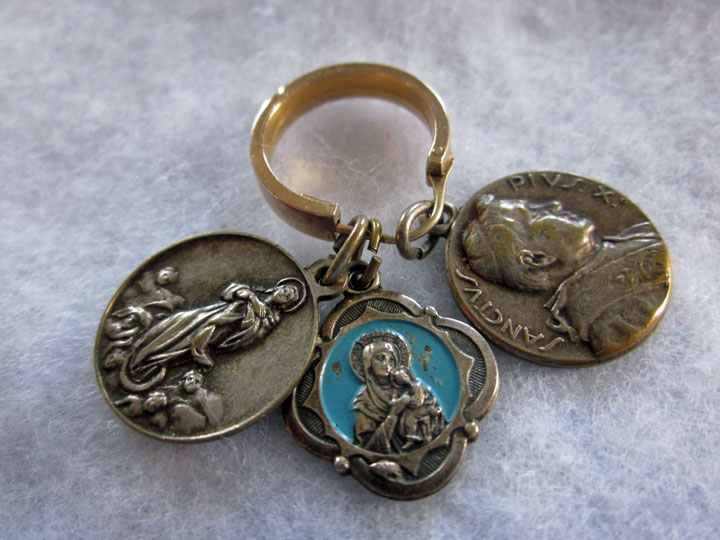
When I was a little girl, maybe even younger than the Bean is now, my grandmother (we called her Ma) gave me treasure.  I remember sitting at the big table in the kitchen with Ma, studying it.


Ma gave me a single gold earring and three religious medals.  One was of the Virgin Mary and child, with a light blue background.  I think Catholics around the world recognize the colour "Virgin Mary blue."  On the other side of the first medal is a male saint holding a cross, with a head or maybe a skull on the table beside him.  I had a heck of a time figuring out which saint he was but after an hour or so of Googling, I'm pretty sure he was St. Gerard Majella.  I'm embarrassed that I didn't recognize him, having attended St. Gerard Majella parish for at least a decade in Sault Ste. Marie.

The other two medals are identical.  In the picture above you can see the two sides of the medal:  on one side is Pope Pius X and on the other is the Virgin Mary's assumption into Heaven.

As a little girl, I'll admit, the medals didn't mean a lot to me.  But I was pretty excited to have a gold earring.  Still, I was needed to know it really was gold.  So, I bit it.  See the marks?


I have treated this much better since the day I received and bit it.  I usually bring it and my rosary with me when I travel.  To keep it safe or to keep me safe?  I'm not sure.

This is a treasure,one of many treasures from my grandmother, not the least of which was my time with Ma.

Tuesday, 12 April 2011

J is for Jeremiah

It is fitting that my grandparents were Hanora and Jeremiah.  Both names are somewhat peculiar to West Cork and both have a few variations.

The Jeremiahs in my family have been known as Jerh or Jerry.  You will occasionally find Jer.  And when I was in Ireland in 1989, I met a colourful fellow known by the short form Miah. 

I like the idea of naming a girl Jeremiah and calling her Miah for short.  Wouldn't that be cool?  My Sweetie didn't think so.

Did you know that Dermot is a form of Jeremiah?  From what I've read, there was a period of time when the Catholic Church operating in Ireland tried to Latinize names.  You'll see this also in some old Sault Ste. Marie Catholic records where the Italian Marys I know were baptized Maria.  It's less obvious to Latinize Irish Gaelic names. Apparently, Con and Connor became Cornelius.  And Dermot and Diarmaid became Jeremiah.  Another form of Dermot, and hence Jeremiah, is Darby.  We refer to our original Moynihan ancestor (as far back as we have been able to take the tree) as Big Darby Mynehane.  You'll find him called Jeremiah Mynehane on some Ancestry trees online.

One last thing.  In case you don't yet have the song running through your head, let me share what inspired this post:  "Jeremiah was a Bullfrog."

No he wasn't, he was my ancestor.

Friday, 8 April 2011

G is for Genetti

If you're from the Sault you know what genetti are.  If you're not, you need to make these cookies.

Let's start with a picture. Here's a recent batch Aunty Anna made for the lucky folks in Saskatchewan.  The Easter colours aren't traditional; usually the icing would be white.  But for Easter, these are pretty:


Here's Cousin Sam's recipe for our grandmother's Genetti.
6 eggs (Ma says to use XL but I only use large)
1 cup of vegetable oil
4 cups flour
5 tsp. baking powder
1-2 tsp anise (I always use 1 1/2 tsp.)
1 cup sugar
Mix all ingredients by hand. Once mixed, to make the genetti shape, take a small amount of the mixture and form into a log shape and then twist, place on cookie sheet. 
Bake 10-12 minutes at 350 degrees, but check the bottoms on them after 8-9 minutes.  Once the bottoms are a nice golden brown, take them out immediately. Cool on wire rack.
Icing -- icing sugar and water.  I always fill up a cereal bowl with icing sugar and add a little bit of water and mix well with a spoon until smooth. Make sure it is nice and white looking and not watery or it won't look or taste good.
I always put a piece of waxed paper on my counter and put the genettis on a wire cooling rack and ice them and let the drip go onto the waxed paper.
I know my grandmother would be happy to share the recipe and may your home smell of genetti.
Sam tells me her genetti taste just as good as Ma's -- so good her dad couldn't tell them apart back when Ma was still making them.

I've only made them once.  I'll tell you, it takes some practice to roll them as evenly as Aunty Anna does.  My Mom frequently makes genetti, but with her arthritis she just can't roll them into the traditional genetti shape. Mom adds a bit of vanilla to the cookie base and some anise to the icing.  She makes them as a drop cookies and they taste just as good.

Who else makes genetti?  Secrets to rolling them?  Fresh batch?  Please share!

Thursday, 7 April 2011

F is for Frank's First Marriage

My grandfather's brother, Frank Bertolo, married my grandmother's sister, Lina Mattioli.  They never had children, and perhaps that is why they ended up like an extra set of grandparents for us kids.

Frank and Lena were a great pair.  They were both hard-working, with a twinkle in the eye.

Tomorrow would have been Aunty Lina's 99th birthday, but she passed away in May 1997, three years after Uncle Frank, whom we called Zio (pronounced see-oh in our family, rather than the proper Italian tzee-oh).

It was only after Aunty passed that I learned that she was Zio's second wife.  It took my by surprise, but my mom had always known it.

So who was Zio's first wife and what happened to her?  I can still only answer the first question.  I was told she was "Indian" and that she ran off with another man.

One day, looking at some Canadian naturalization records on the Canadian Library and Archives site, I saw Uncle Frank's naturalization in February 1927 with his wife Annie.   So there's her first name: Annie.

Then last year, searching the Drouin collection on Ancestry, I found Frank and Annie's marriage record.  Her maiden name was Davey.  They were married in January 1924 in Sault Ste. Marie.  The church record says Frank was 18 and Annie 15.  Their Ontario civil record of the marriage is also on Ancestry.  Despite the same marriage date, the civil record says Frank was 21 and Annie 16.  Hmm.  Uncle Frank was born September 10, 1905.  I have known that all my life, plus I've seen his Italian birth registration.  I've also found Annie's birth record.  She was born August 30, 1910.  That would have made Frank 18 and Annie just 13.

TIP:  Don't believe that all the facts, even on original records, are accurate.

In a future post, I'll tell you about the book I've been reading, Genealogical Standards of Evidence: A Guide for Family Historians by Brenda Dougall Merriman.  In short, you will often be faced with a collection of records offering contradictory facts.  The book provides guidance on assessing each record's reliability.  Some of the guidance is common sense but you know how common that is.  Think about Annie's age.  Would you put your faith in the provincial birth registration by her father or the age she or her groom gave the priest?
Having three possible birth years for Annie made it a little tough to find her in the 1910 Canadian census.  There were three girls named Annie Davey or Davie in Ontario at the time, each roughly the same age.  One lived in Toronto.  There was a Cree girl in Moose Fort, living with her Hardisty grandparents.  And one Annie was living with her parents and Dumbar grandparents near the Sault. 

TIP:  When you have people of the same name and age in the same area, see what other facts can distinguish one from the other.

You'll be hard pressed to find Annie in Plummer Township near the Sault; her surname appears to be written as Davil.  I thought Zio's Annie was the Cree girl.  But the grandparents in Plummer are the ones that match the mother's maiden name, Dunbar, listed in the church and civil marriage record as well as Annie's birth registration.  I have no idea where the story came from that Annie was "Indian."  That 1910 Census says her parents were Scottish.

TIP:  Some family stories have been embroidered over the years, but there's usually a grain of truth in them somewhere.  And you will want to find it.

So what happened to Annie?  I understood that Zio married Aunty Lina in 1932.  But they didn't marry in the Catholic Church until 1959.  I found a link to Frank and Annie on an Ancestry family tree that showed their divorce date.  I contacted the Ancestry member who posted the tree to ask the source of the divorce date.  I had searched a number of databases but never found a divorce record.  To my embarrassment, I was told that the divorce date was written at the top of the civil marriage record!


TIP:  Look at documents closely to capture all the information they hold.

Mom says Aunty Mary has Frank and Annie's divorce papers, but I haven't seen them yet. [By the way, Happy Birthday, Aunty Mary!]

Unfortunately, Annie's relative who had posted the tree knew nothing more of Annie.  Perhaps years from now, we'll find a marriage record or death record for her -- that is, assuming we can tell whether it's our Annie or the one from Toronto or Moose Fort.  Until then, Annie Davey will remain a mystery.

Whereever Annie went, whyever she went, I'd have to thank her.  Because if you knew Aunty and Zio, you know they were meant for each other.

Saturday, 2 April 2011

B is for Bannia

In the fall of 2000, my mom and I spent three weeks in Italy together.  We had a wonderful time.  While we were camped out in Venice, we took a day trip up to Bannia, the village where her father (we called him Babbo) was born.  I am forever grateful to the Giuseppina Facca, who recently passed away, and her daughter Daniela having us picked up at the Pordenone train station and driven around Bannia.  We were able to meet some Bertolo relatives, one of whom bore a strking resemblance to Babbo.

Mom said Babbo had told her that when he was a boy, he used to sit under the fig tree beside the church in Bannia.  He never returned to Italy after emigrating in 1913.  But we went to see if the tree still stood.  We didn't see the tree, our Bertolo cousin told us it stood where the village war memorial is now.  But it was sure worth the trip.

What we did find was a history of the parish, SS. Perpetua e Felicita di Bannia, which had been written by the parish priest, Stefano Battiston.  The book includes an 1895 census of the parish, Statistica della popolazione di bannia al 1 gennajo 1895.  Like many old censuses, it only gives the names of the head of the household, plus the number of males and females living there.  As a parish census, it also shows how many in the household had received the sacraments of Communion, Confirmation and Marriage.  There were 194 families in Bannia in 1895, with a total of 1,374 people.  I won't copy the census without the permission of Don Stefanno, but here's a summary of the family names in Bannia at the time:

(family name:  number of households in Bannia in 1895)

Agnolet:  1
Babuin:  2
Bassetto:  1
Basso:  2
Battel:  6
Battiston:  1
Bertolo:  10
Bertoli:  1
Bertoja:  1
Bisaro:  2
Borean:  3
Bortolussi:  1
Boscariol:  2
Bottega:  1
Bottos:  1
Boz:  1
Buligan:  5
Candido:  4
Calderan:  1
Callegari:  4
Carlis:  1
Ceolin:  1
Cepparo:  1
Ceschin:  1
Chiarot:  1
Cancian:  1
Dal Tio:  2
Da Re:  1
Del Bianco:  1
De Lorenzi:  2
Dolcetti:  1
Dreon:  2
Fabbro:  1
Favret:  2
Facca:  9
Feruglio:  1
Frattolin:  2
Gallio:  1
Gasparotto:  2
Grillo:  5
Innocent:  1
Lovisa:  1
Manzon:  1
Marson:  3
Marta:  1
Morassutti:  2
Mores:  1
Moret:  1
Morettin:  2
Maura:  1
Mio detto Parussolo:  1
Mio detto Tesolin:  3
Muzzin:  14
Modolo:  1
Montegnacco:  1
Pasut:  2
Pavan:  8
Pellarin:  4
Pighin:  1
Pignat:  1
Pezzutti:  1
Praturlon:  1
Puppa:  2
Puppulin:  1
Quarin:  1
Ragogna:  1
Redigonda:  1
Ros:  2
Rosin:  1
Rosset:  1
Rovere:  1
Roversi:  1
Rubli:  1
Rugo:  1
Santin:  1
Santarossa:  1
Sacilotto:  1
Sciardi:  1
Susanna:  4
Toffoli:  1
Tossut:  1
Vaccher:  10
Vida:  1
Villalta:  1
Zanese:  1
Zuccatto:  14
Zuccet:  1

Do you have roots in Bannia?  Please let me know if you'd like me to look up more info on your ancestors from this census.

If you are from Sault Ste. Marie, you will recognize many of those surnames, particularly Bertolo, Candido, Caligari, Chiarot, Fabbro, Facca, Marson, Mio, Muzzin and Zuccatto.  One of the research projects I would like to take on is to figure out who was the first man from Bannia to come to Sault Ste. Marie.  In our family, I believe it was Mino Bertolo, brother to my great-grandfather.  I don't know if he was the first from Bannia, but I do know, from looking at Ellis Island records over the years that an awful lot of citizens of Bannia headed to Sault Ste. Marie to join their "brother Mino Bertolo," "uncle Mino Bertolo," or "friend Mino Bertolo."

Do you know who was the first from Bannia in the Sault?

P.S.  In a future post, I'll share more information about the civil records from Bannia (and the rest of Fiume Veneto) that are available on microfilm through the LDS Family History Centres.  They are really tough to read, but thrilling too.  Within minutes of scanning one of the three films I ordered I found Uncle Frank's birth registration and Ernesta Candido's too (her maiden name was Bertolo).  More on that later!

Wednesday, 30 March 2011

A to Z Challenge Preview

I'm in Washington now, limited to 30 minutes at the hotel computer, but I haven't forgotten my commitment to the A to Z Challenge.  I have prepared.

Through the month of April, every day but Sunday, I will be blogging about a topic beginning with a letter from A to Z.  Here is a taste of what's coming up.  Hope you will be back to read them:

  • This being a genealogy blog, the first post is going to be "A is for Addiction."
  • Stay tuned for "B is for Bannia" where I'll share a summary of the parish census from Bannia, a frazione of the Comune di Fiume Veneto in the Friuli region of Italy.  The census is from 1895.  Friends and family from Sault Ste. Marie will recognize many of the families.
  • "C is for Caherolickane" -- it's not just hard to say, or even a pretty background picture.  Writing this blog helped me figure out a bit more about one leaf on the family tree.
  • "D is for Devon" -- that's Devonshire, where the cream comes from, and my favourite Burrows gents.
  • "E is for Ellis Island" -- if you're researching your family tree in North America, chances are you'll find one of your peeps coming through Ellis Island.
More to come.  I'm still deciding if F will be for Fano, where my grandmother was born, or for Uncle Frank's first marriage.  What do you think?  G is definitely genetti cookies (thank you Aunty Anna).  And there is much more to come about the Moynihans, Burrows and others in my family tree.

If this A to Z challenge intrigues you, please check out some of the other 800!! bloggers also covering A to Z through April.  You can find links to their sites on the Tossing it Out blog.

And any of you who ever have to pack a lunch or feed a little one, please check out Kim's blog The Lunch Box.  I first learned of the Challenge on Kim's site.  I can't wait to see what delicious and practical suggestions she'll have for us through the A to Z Challenge. 

So long from Washington.  Come on back Friday, April 1 for the beginning of my genealogical take on the A to Z Challenge.

Saturday, 19 March 2011

Surname Saturday -- Iop

If there are other genealogy bloggers out there blogging the Iop family name this Saturday, I sure want to meet them.

Iop is a difficult name to research online.  Do a Google search for Iop and you get a lot of computer references, among other things.  The last time I searched for Iop on Ancestry, I got a lot of references to Arthafad Ap Iop, born  in the year 885 (and no, I'm not missing a digit).  But I'm not looking for any Welsh Ap Iop.  My Iop relatives are from the Friuli-Venezia-Giulia region in Northern Italy.

My great-grandmother, Maria Iop, was born in 1879 in Pescincanna, a frazione of the Commune de Fiume Veneto, now in the Province of Pordenone.  The village is close to the city of Pordenone.  Her parents were Francesco Iop and Marianna Sutto.

Maria married Giuseppe Bertolo of the nearby frazione of Bannia.  In 1908, Giuseppe left Italy to go to Sault Ste. Marie, Ontario, Canada, where his brother Mino had established himself.  Maria appears to have been pregnant as he left; she had her fifth child, Elena Bertolo in 1909.  One baby had died very young, so Maria Iop was raising four young children without her husband.  Giuseppe later returned to Italy, at least for long enough to father Olivo, who was born in 1912.  In that same year, Giuseppe returned to Canada for good.  Then in April 1913, Maria and her children (Luigi, Francesco, Alessandro, Elena and Olivo) left to join Giuseppe in the Sault.

Maria and her children set sail from Le Havre on the S.S. La Provence on April 12, 1913.  They landed at Ellis Island in New York City on the 19th.  Maria's passport indicates that she was illiterate in Italian.  She was 33 and travelling with five children who ranged in age from nine down to a mere eight months.  Imagine.  At least she had her brother-in-law, Olivo Bertolo, on the voyage with her.

Maria and Giuseppe quickly established themselves in Sault Ste. Marie, where they had several more children:  Mariana, Amelia, Ontaria and Assunta.  Life wasn't all wonderful.  Shortly before Christmas in 1921, Marianna died at the age of seven and a half, of convulsions.  In 1932, Giuseppe died of stomach cancer.

Maria herself lived until 91 years of age.  I wish I remembered more about her, but I was a small child when she died.  And because I didn't speak Italian and she spoke little English, we didn't spend much time together.  I recently looked at the four-generation picture taken with her, Luigi, mom and me when I was a baby.  Boy, they looked proud.  That I remember.

Maria Iop never returned to Italy.  To my knowledge, none of her family came to Canada.  We have a couple of pictures and memorial cards with Iop relatives in them.  But we've had no contact with the Iop family since Maria left in 1913.  From the Italian White Pages online, it looks like there are a few Iops still in the area.  Maybe they're looking for us?

Benvenuti, famiglia Iop!